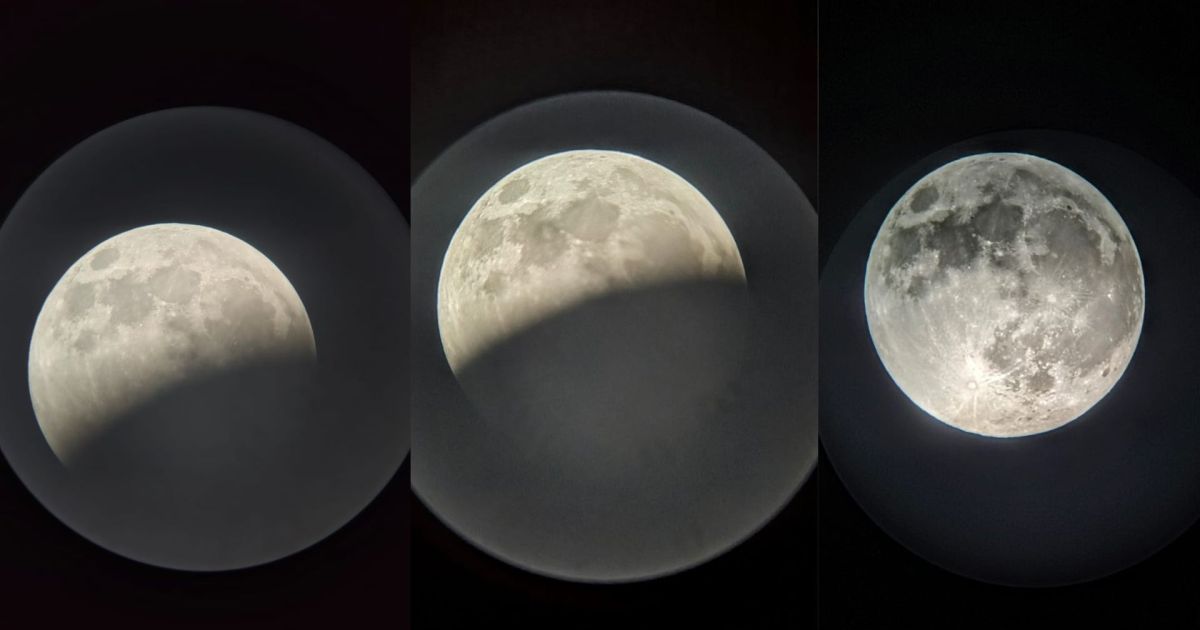
A partial lunar eclipse featuring a Blood Moon was visible across Brazil overnight from Thursday into Friday, drawing stargazers and astronomy enthusiasts across the country to watch the rare celestial event.
The celestial spectacle reached its peak at approximately 1:12 am Brasilia time on Friday, August 28, when Earth shadow covered roughly 93 per cent of the full Moon.
Astronomical observations began at 11:34 pm on Thursday evening as the outer edge of Earth shadow first made contact with the lunar surface.
Observations from Minas Gerais
In São Thomé das Letras, a municipality located in the Mantiqueira Mountains of the southeastern state of Minas Gerais, astronomer Emerson Roberto Perez captured the early progression of the phenomenon.
Perez explained that photographs taken at 11:34 pm showed the right side of the lunar surface beginning to darken as the eclipse got underway.
Within 11 minutes of the eclipse starting, observers could already see a substantial portion of the Moon obscured by Earth shadow.
Although cloud cover later moved over the observation point in Minas Gerais, the captured images of the darkening satellite remained striking.
Earth curvature and historical evidence
During the observation, Perez highlighted a significant historical connection linked to lunar eclipses.
He noted that the shadow cast across the Moon during an eclipse forms a visible curve rather than a straight line.
Perez said that astronomers between 2,000 and 3,000 years ago used this curved shadow as empirical proof that Earth is spherical rather than flat, resolving ancient debates about the shape of the planet.
A partial lunar eclipse occurs when Earth aligns directly between the Sun and the Moon, casting its shadow across the lunar disc. The reddish tint associated with a Blood Moon occurs because Earth atmosphere scatters shorter wavelengths of light while refracting longer red wavelengths onto the Moon surface.
Public viewing events in Maranhão
Across the country in São Luís, the coastal capital of the northeastern state of Maranhão, local academic and astronomical groups organized a public viewing session to gather residents for the spectacle.
The event was jointly hosted by the Ilha da Ciência Scientific Dissemination Laboratory, based at the Federal University of Maranhão, and the Maranhão Astronomy Society.
The Federal University of Maranhão regularly conducts scientific outreach projects through its Ilha da Ciência program to promote science education and astronomy among the public.

The overall eclipse sequence began at 11:34 pm on Thursday and was scheduled to conclude around 2:51 am on Friday morning.