Senior National Police commanders in Ceuta say frequent visits by Spanish government and opposition politicians are pulling officers away from handling a severe migration crisis.
Operational leaders consider the steady stream of visiting officials counterproductive, warning that security teams are overwhelmed as they struggle to maintain daily order across the autonomous city.
High-level police sources explained that the problem stems from the requirement to deploy special security operations for every visiting dignitary. Those assignments force commanders to withdraw officers from street patrols at a time when the city is facing an unprecedented border situation.
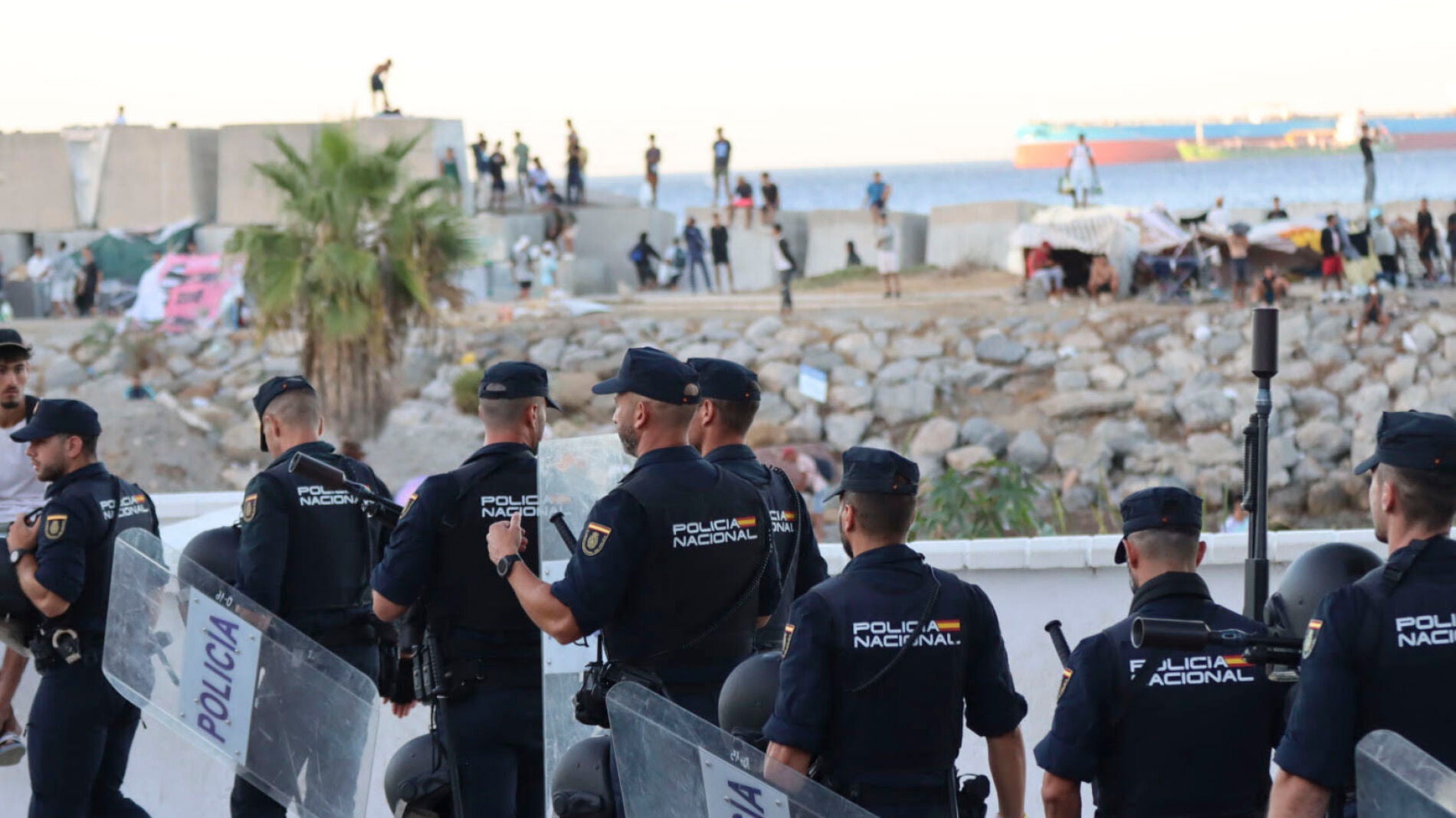
Whenever a public official travels to Ceuta, the National Police must organize a dedicated security detail. Operational commanders are required to coordinate bodyguards, undercover vehicles, specialized protection units, and escort personnel to accompany high-ranking authorities.
Senior police officials reported feeling overwhelmed by the additional burden, describing the current workload as unsustainable despite extraordinary efforts by local staff. A police commissioner told LA RAZÓN that a major portion of available resources is being consumed by what he described as a permanent procession of institutional visits.
The strain is heightened because many visiting politicians request trips to sensitive locations across the city. Security details must be intensified when officials inspect high-risk areas such as the El Príncipe neighborhood, the border district of Benzú, and the beaches at El Tarajal and El Trampolín.
A second police source stated that those officers are urgently needed back on the street to protect citizens and support an operational force that is already under severe pressure. A third commander emphasized that Ceuta currently requires officers focused directly on security, crime prevention, and investigation, rather than personnel dedicated continuously to escorting visiting dignitaries.

Border Entries and Enforcement Challenges
Ceuta, a Spanish autonomous city located on the North African coast bordering Morocco, has been living on the edge since a mass border crossing began a month ago. Spain's other North African enclave, Melilla, lies further east along the Mediterranean coast.
The current emergency started between July 20 and July 31, 2026, when 72,000 people entered the city irregularly across the border with Morocco. Most of those entering made the crossing by swimming around coastal barriers.
The surge followed a Spanish Supreme Court ruling that prevents authorities from immediately returning individuals who enter Spanish territory in that manner. The judicial decision has altered border enforcement procedures along the North African frontier.
The crisis remains far from over a month after the initial surge. Although Spain's Ministry of the Interior dispatched significant reinforcements of National Police and Civil Guard officers throughout August, top operational chiefs say the additional staffing has proven insufficient to manage the ongoing emergency.
European Support and Security Risks
The shortage of personnel has affected both humanitarian processing and public order. Spain's Interior Department, led by Interior Minister Fernando Grande-Marlaska, recently requested assistance from Frontex, the European Union border and coast guard agency, to speed up the triage and administrative processing of newly arrived foreigners.
At the same time, security forces are struggling to prevent potential outbreaks of violence. Police are managing tensions involving both recent arrivals and far-right ultra groups that have traveled to the North African territory during the crisis.
Month-Long Timeline of Political Visits
A continuous sequence of visits by representatives from both the ruling coalition and opposition parties has taken place since the emergency erupted. The Spanish government is led by the Spanish Socialist Workers' Party, while opposition criticism has been spearheaded by the conservative People's Party and the right-wing Vox party.
Institutional visits began on July 31, 2026, when Prime Minister Pedro Sánchez traveled to Ceuta alongside Interior Minister Fernando Grande-Marlaska, just one day after the initial massive crossing. Sánchez described the events at the border as an attack on Spain's territorial integrity.
Marlaska returned to Ceuta on August 1 to inspect police operations on the ground. That same day, Alberto Núñez Feijóo, leader of the main opposition People's Party, made his first visit to tour the city and border zone, where he accused the government of reacting too late to a situation that demanded a coordinated state response.
On August 2, Vox leader Santiago Abascal visited the autonomous city, describing the influx of migrants as an invasion and demanding a larger military deployment along the border perimeter.
Cabinet ministers continued to arrive throughout the month. Youth and Children Minister Sira Rego arrived on August 7, holding meetings over the following days. Territorial Policy Minister Ángel Víctor Torres visited on August 10 to strengthen coordination between central government authorities and the Autonomous City administration.
Foreign Affairs Minister José Manuel Albares arrived on August 11, focusing his agenda on diplomatic relations with Morocco, migrant return protocols, and the defense of Spanish sovereignty. Defense Minister Margarita Robles inspected deployed military units on August 12, declaring that neither Ceuta nor Melilla would be touched.
Marlaska made his third trip to Ceuta on August 13. Health Minister Mónica García traveled to the enclave on August 16, followed by Inclusion Minister Elma Saiz on August 17.
Opposition leaders also maintained a steady presence. People's Party Secretary General Cuca Gamarra visited on August 18, and Feijóo returned for his second trip on August 19 to present policy proposals regarding security, returns, and relations with Morocco. Regional President of Andalusia Juanma Moreno visited on August 20.
In the final week of August, First Vice President and Economy Minister Carlos Cuerpo arrived on August 24 to evaluate the economic consequences of the crisis. Torres returned on August 25 to assume sole command of the government response. Former Prime Minister José María Aznar made the latest high-profile opposition visit on August 27, calling for firmer action in defending Spanish sovereignty against Morocco.