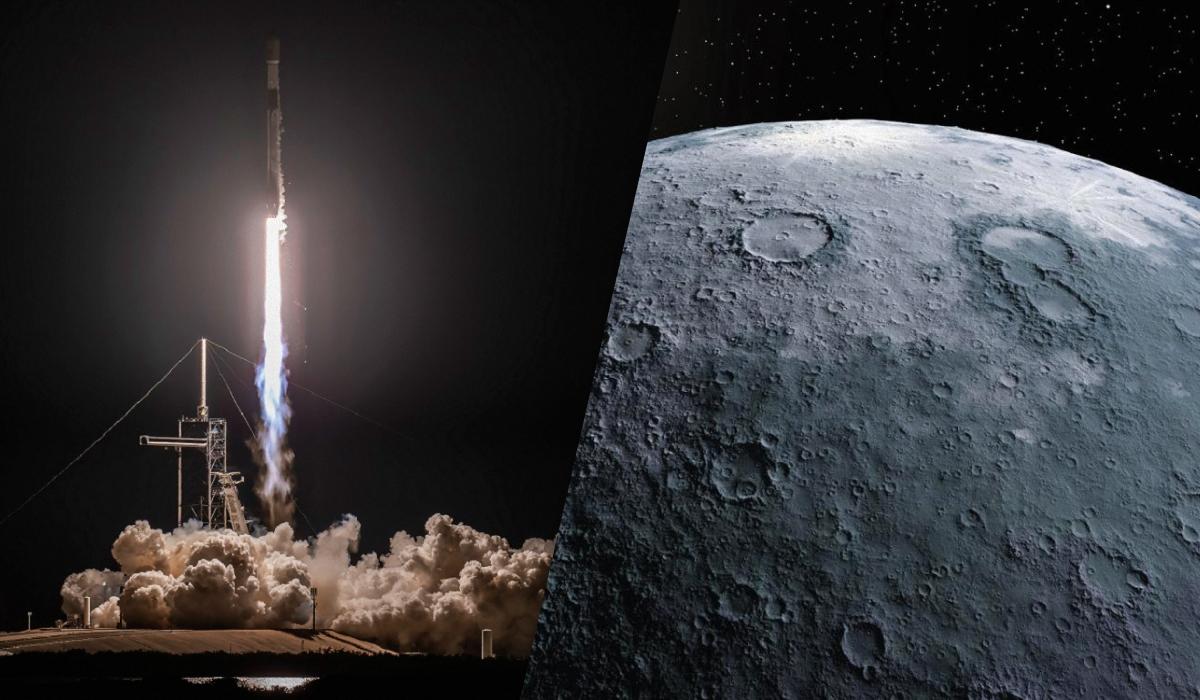
A discarded upper stage from a SpaceX Falcon 9 rocket is expected to slam into the Moon on August 5, travelling at about 2.43 kilometres per second, according to the BBC.
NASA's Center for Near-Earth Object Studies said the stage, from a Falcon 9 rocket launched in January 2025, will strike the lunar surface after independent astronomers noticed it had drifted onto a collision course with the Moon.
NASA spokesman Jimmy Russell said there is no danger to Earth. He said NASA would keep tracking the rocket stage for educational purposes and would later observe the impact site for scientific research.
A joint US-Japan mission
The rocket was launched as part of a joint mission between the United States and Japan, which last year aimed to deliver two landers and scientific equipment to the Moon.
Part of the Falcon 9 is reusable and designed to return to Earth for use on a future mission. But other sections separate in space and are left drifting in orbit until they eventually collide with another celestial body. The piece heading for the Moon is the upper stage, roughly the size of a five-storey building and weighing at least 4,000 kilograms on Earth.
Impact predicted near Einstein crater
Astronomer Bill Gray, who was first to identify the stage's trajectory, said it will come down near the Einstein crater, on the Moon's sunlit side. He predicted the impact would carve out a crater more than 17 metres across.
The collision is expected at 06:35 GMT, or 09:35 Kyiv time.
Dr Matt Bothwell, a public astronomer at the University of Cambridge, described it as a genuinely huge object crashing into the Moon. He said it poses no danger and can simply be watched as a spectacle, adding that the object will hit the surface and throw up a huge column of dust, possibly 50 kilometres high or more, which will spread outward over time.
Bothwell said the collision will be more dramatic than it would be on Earth because the Moon has no atmosphere. He said the impact will not be visible to the naked eye from Earth, but anyone with access to a modern telescope should be able to see a flash from the Moon's surface.
A rare scientific opportunity
Bothwell said the educational value of the event would be even more significant, calling it a unique opportunity to study what happens when an object collides with the Moon.
Twenty-three astronomers have issued an appeal urging colleagues and amateur astronomers to join forces in observing the impact. No artificial or natural collision has ever been directly recorded on the Moon's sunlit side before.
Some of the most powerful space observatories will take part in tracking the event. NASA's Lunar Reconnaissance Orbiter will photograph the area before and after the impact, while the South Korean satellite Pathfinder will attempt to capture the moment of collision itself.