

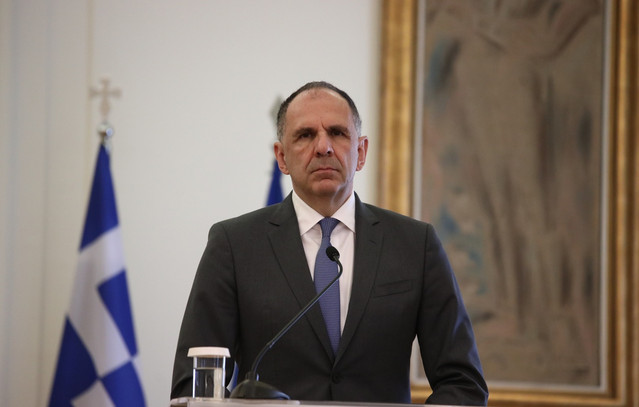
Greek Foreign Minister George Gerapetritis said the European Union would support Greece against any threat, while making clear that dialogue with Turkey does not mean any retreat from Greece's national positions.
Gerapetritis made the comments speaking on OT FORUM, the hybrid channel of the newspaper Economic Post (Oikonomikos Tachydromos), held as part of the 90th Thessaloniki International Fair. The fair is an annual trade exhibition in northern Greece that Greek governments traditionally use as a platform to set out policy. He addressed recent developments in Greek-Turkish relations, Ankara's reactions to Greek initiatives in the Aegean Sea, and Athens' broader foreign policy strategy.
Greek démarches to Turkey
Gerapetritis revealed that Greece has submitted formal démarches to the Turkish Foreign Ministry, both over the issue of marine environmental parks and over Ankara's reactions to special spatial planning schemes being advanced by Athens.
He said Greece had also informed its European partners at the Foreign Affairs Council, requesting the support and solidarity of both the European Union and its member states.
He said it went without saying that Europe would provide its support to Greece against any threat to the country.
According to the minister, Greek positions are based on international and European law, and he argued that Turkish claims have already been rejected in conclusions of the European Council and in reports of the European Parliament.
'Dialogue does not mean retreat'
Gerapetritis stressed that Athens seeks to keep communication channels with Ankara open even during periods of tension.
He said the value of genuine, substantive diplomacy lay in being able to keep talking even where differences exist.
He said that over the last three years a satisfactory level of communication had been built with Turkey, producing results mainly on migration and economic cooperation.
However, he acknowledged that the current period is marked by rising tension, which he linked to unilateral actions by Turkey.
He said the necessary dialogue did not mean there would be any retreat from national positions, which he described as sacred for Greece.
The dispute over maritime boundaries
Gerapetritis singled out the delimitation of the Exclusive Economic Zone and continental shelf as the core issue that needs to be discussed between the two countries. Greece and Turkey, both NATO members, have long-running disagreements over sovereignty and maritime boundaries in the Aegean Sea and the eastern Mediterranean.
He repeated Greece's established position that the only dispute capable of being referred to international jurisdiction concerns the delimitation of maritime zones.
By contrast, he said, Turkey links the issue to other matters that Athens considers not open to negotiation.
He said that without convergence on this point, the discussion could not even begin.
He added that the three pillars of Greek-Turkish dialogue, political dialogue, the positive agenda and the Confidence Building Measures, remain in place.
Greece as a 'security exporter'
Gerapetritis spoke at length about the strengthening of Greek defence capability, arguing that the country has become a security factor in the region in recent years.
He said Greece had significantly upgraded its armed forces through cooperation with a range of allies, citing French-built Belharra frigates, French Rafale fighter jets, the acquisition of American F-35 stealth fighter jets, and defence cooperation with Israel.
He said Greece was arming itself intelligently, drawing on allied countries, and stressed that the country does not depend on a single supplier.
He also described the Greek defence industry as a diplomatic and geopolitical weapon, saying the country has taken on a larger role in regional security.
Contacts with Turkish intelligence
Referring to the recent visit of Ibrahim Kalin, the head of Turkey's National Intelligence Organisation, Gerapetritis said intelligence services of neighbouring states maintain communication channels on matters of shared concern.
He listed the crisis in the Middle East, safety of shipping, Libya, Syria and counter-terrorism among the topics involved.
He also said cooperation on intelligence had contributed to a reduction of around 80% in irregular migration flows from Turkey.
'Greece is not defined by others'
Concluding his remarks, Gerapetritis said Greece is today in a stronger international position than ever before.
He said Greek foreign policy had achieved a level of real momentum and strength that is not defined by others.
He said the country had developed strategic relations with the United States, Israel, countries of the Arab world and India, and would soon take on the presidency of the United Nations Security Council, a position that rotates monthly among the council's members, followed by the presidency of the Council of the European Union, which rotates among member states every six months.
He said Greece had independently reached the strongest point in terms of international power it had ever held, and stressed that Athens would continue to act on the basis of international law and its strategic alliances.


