


President Luis Abinader has ordered educational district directors in Santo Domingo to submit regular reports on school meal incidents in the Dominican Republic. The directive was issued on Monday during the launch of LA Agenda Semanal at the Palacio Nacional, coinciding with the official start of the 2026-2027 academic year.

Under the instruction, district directors across the country must file biweekly or monthly reports tracking any problems that arise with school breakfasts and lunches. Abinader requested that officials document localized incidents in individual school centers rather than waiting for widespread emergencies to occur.
Abinader stated during the briefing that while a food problem might not represent a general event, tracking particular events creates a necessary statistical record. He explained that systematic data collection is essential to determine how frequently incidents take place and to ensure proper official follow-up for cases requiring attention.
The Palacio Nacional in Santo Domingo serves as the official seat of government and workplace for the President of the Dominican Republic. LA Agenda Semanal is a weekly interactive press conference held at the executive palace, designed to provide journalists with updates on government policies and public services.
Nutritional standards and cycle menu
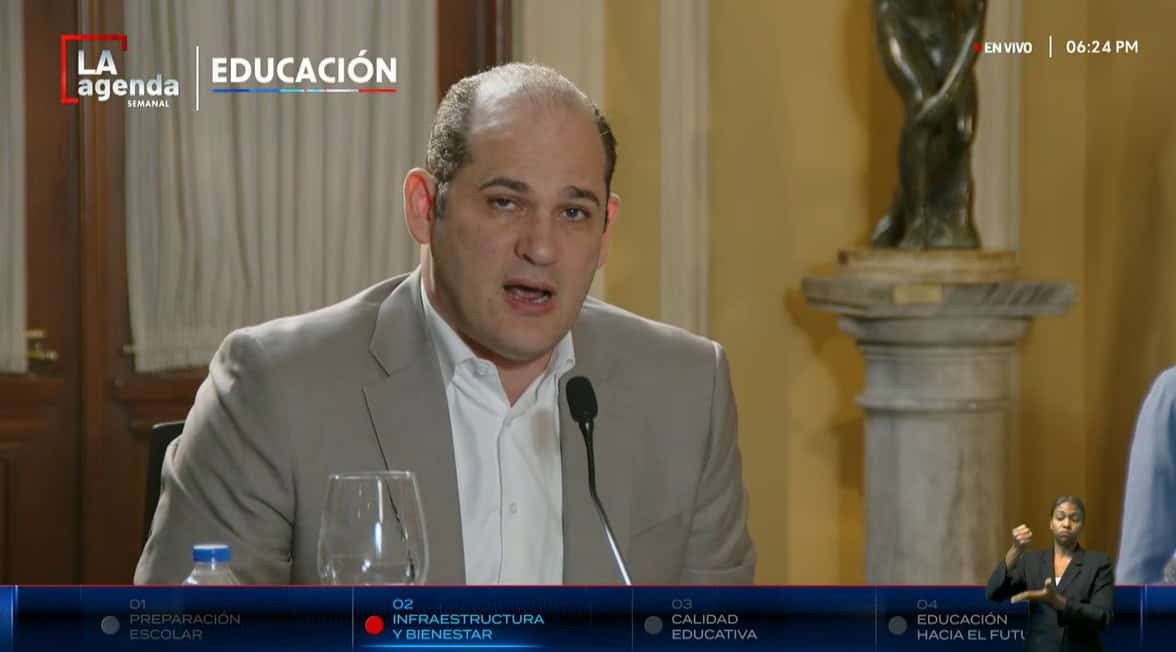
Adolfo Pérez, director of the Instituto Nacional de Bienestar Estudiantil, outlined the nutritional structure governing the national school feeding program during the meeting. He stated that the menu is created by a specialized health and nutrition team composed of pediatricians and expert nutritionists.
The dietary plan operates on a cycle of 25 distinct food combinations distributed across five days a week over five consecutive weeks. Under this schedule, public school students receive a different meal combination every day for 25 school days before the rotation restarts. Officials added that preparations now feature reduced amounts of salt and sugar to ensure balanced nutrition for children and adolescents.
Monitoring and supplier oversight
Responding to concerns about potential student illness from food consumption, officials reported that a dedicated quality control and monitoring department oversees all items served through the school feeding system. Inspectors conduct continuous visits to school centers, commercial bakeries, and industrial kitchens responsible for preparing student meals to verify hygienic conditions and food quality.
When inspectors discover non-compliance or conditions that compromise meal standards, administrative sanctions are imposed on the responsible providers. Presenters at LA Agenda Semanal confirmed that no general food safety incidents were recorded during the previous school year, though they stressed that ongoing supervision remains crucial.
The Instituto Nacional de Bienestar Estudiantil is a decentralized agency attached to the Ministry of Education that manages student welfare, nutrition, and health services in Dominican public schools. Monitoring efforts will involve school directors, classroom teachers, and local parent-teacher associations, known as the Asociaciones de Padres, Madres, Tutores y Amigos de la Escuela.
Abinader concluded that continuous supervision is always beneficial for public programs. He reiterated that maintaining accurate statistics on school breakfast events will enable educational authorities to identify trends and determine appropriate response measures across all districts.


