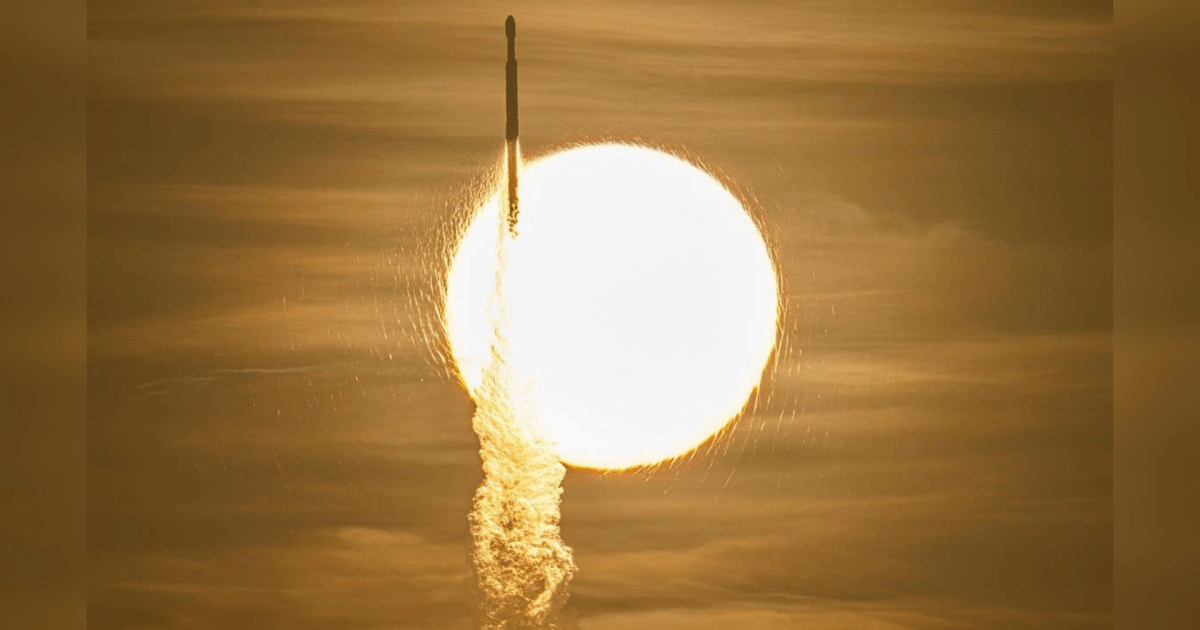
NASA launched the Nancy Grace Roman Space Telescope aboard a SpaceX Falcon Heavy rocket from Florida on Sunday to study dark energy and exoplanets.
The $4 billion observatory lifted off at 8:26 a.m. Brasilia time from the Kennedy Space Center in Cape Canaveral on an initial five-year mission to explore some of the deepest mysteries of the cosmos. Space agency officials stated that the launch took place nine months ahead of schedule.
Following the successful liftoff, NASA Administrator Jared Isaacman said that Roman would give Earth a new atlas of the universe.
The spacecraft, which is roughly the size of a commercial bus, was developed to conduct deep cosmic surveys across vast regions of space. Scientists plan to use the observatory to investigate dark energy and dark matter, test gravity across massive cosmic scales, map billions of galaxies, study black holes, and discover previously unobserved planets beyond our solar system.
Investigating Dark Energy and Dark Matter
Among the primary objectives of the mission is uncovering the nature of dark energy, the mysterious phenomenon associated with the accelerating expansion of the universe. In modern cosmology, dark energy is understood as a repulsive force driving galaxies apart, making its exact nature one of the most significant unsolved problems in physics.
Researchers will also use the observatory to study dark matter. Dark matter does not emit, absorb, or reflect light, rendering it invisible to conventional astronomical instruments. However, its immense gravitational influence shapes the cosmic web, binding galaxies together and governing the movement of stars.
By conducting deep surveys of the universe, the Roman mission aims to gather crucial new clues about both dark energy and dark matter. The gathered data will assist astronomers in reconstructing how the universe formed, structured itself, and continues to evolve over billions of years.

Searching for Exoplanets and Rogue Worlds
Beyond mapping large-scale cosmic structures, the Roman telescope will search for planets located outside our solar system, known as exoplanets. Astronomers hope to discover and characterize thousands of distant worlds, ranging from gas giants to rocky planetary bodies.
The mission includes a dedicated effort to search for rogue planets, which are planetary-mass objects that wander through interstellar space without orbiting a host star. These solitary worlds roam freely across galaxies, having been ejected from their parent star systems, making them extraordinarily difficult to detect with traditional observational techniques.
Equipped with advanced optical instruments, the observatory is designed to detect faint, low-luminosity objects and reveal cosmic structures that were previously hidden from astronomers.
Surveying the Cosmos Faster Than Hubble
The Nancy Grace Roman Space Telescope is designed as a successor to NASA's landmark observatories, including the Hubble Space Telescope, launched in 1990, and the James Webb Space Telescope, launched in 2021. Both Hubble and Webb remain fully operational, providing targeted views of specific cosmic targets.
Roman features broad-field survey capabilities more than 1,000 times faster than those of Hubble. While Hubble and Webb focus on narrow views of individual targets, Roman can map massive swathes of the sky simultaneously, capturing fundamentally different scientific observations that were impossible with older technology.
To process these expansive sky surveys, the mission will share unprecedented volumes of scientific data with researchers and the public. Jeremy Perkins, a Roman telescope integration and testing scientist at NASA's Goddard Space Flight Center, said the telescope is expected to transmit one terabyte of data per day. Perkins noted that transmitting this volume daily is equivalent to streaming one million songs across a distance of 1.6 million kilometers back to Earth.

Journey to Lagrange Point 2
The observatory will now spend approximately three months traveling to its final operational position at Lagrange Point 2, commonly known as L2. Located about 1.6 million kilometers from Earth, L2 is positioned roughly four times farther away from Earth than the Moon.
At Lagrange Point 2, the gravitational pull of the Sun and Earth balances the orbital motion of a spacecraft. This position allows observatories like Roman and Webb to maintain a stable location relative to Earth while shielding instruments from solar heat and using minimal propulsion fuel.
Upon reaching L2, Roman will undergo a commissioning phase to test its scientific instruments in space and deploy the high-gain antenna responsible for relaying images and data back to Earth. NASA promises to share the mission's vast datasets with the scientific community, opening new frontiers in astrophysics.