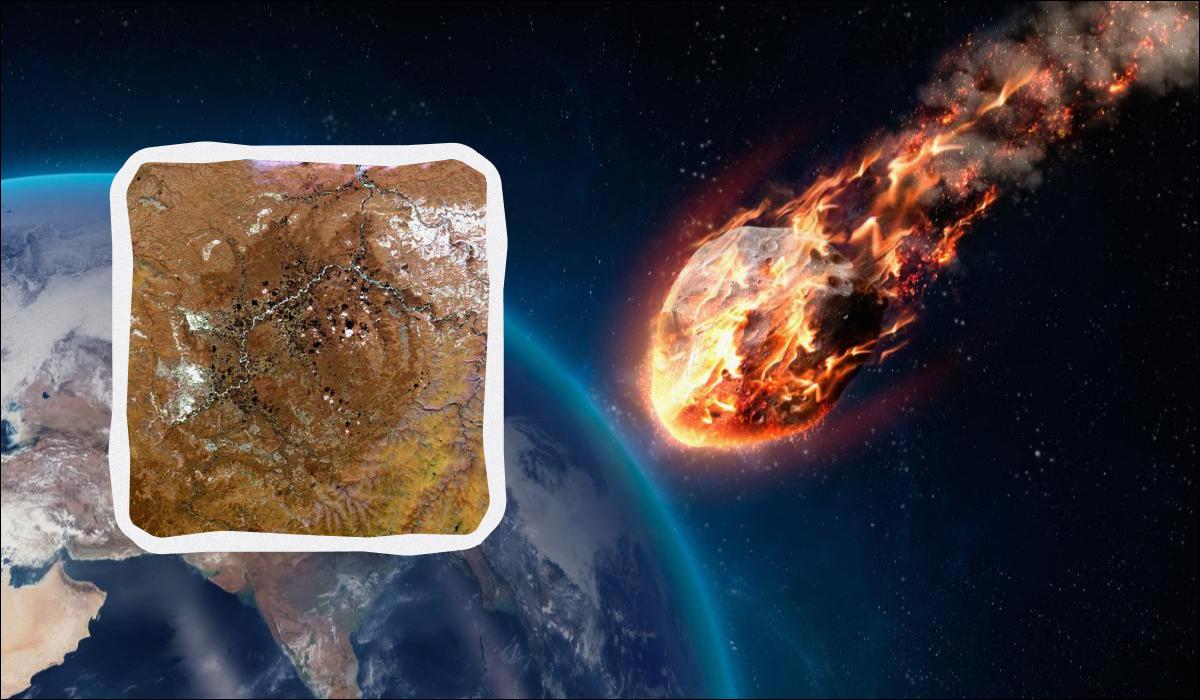
A seven-kilometre asteroid crashed into northern Siberia about 35 million years ago, creating the 100-kilometre Popigai crater and instantly transforming rock graphite into diamonds.
The collision ranks as the fourth largest confirmed impact structure on Earth, according to a report by science publication Discover Wildlife. The immense pressure generated by the impact transformed graphite deposits in the local rock into diamonds across a radius of up to 13.6 kilometres from the epicentre.
Scientists believe that while the resulting stones are likely unsuitable for fine jewellery, they hold strong potential for heavy industrial applications. Graphite and diamond are both pure carbon forms, but shock waves from cosmic impacts compress carbon into dense, ultra-hard industrial minerals.
The crater lies in an extremely remote region of the Russian Arctic, roughly 300 kilometres east of the settlement of Khatanga and 880 kilometres north-east of the industrial mining city of Norilsk. For decades, scientific investigation was hampered by the harsh terrain and strict security surrounding the region's vast diamond reserves, before a 1997 scientific expedition achieved a major research breakthrough.
Cosmic collisions and climate shifts
Subsequent research indicates that the Popigai asteroid strike may have coincided with two other major impacts, the Chesapeake and Toms Canyon collisions.
If scientists confirm these matching timelines, it would suggest a massive disruption within the main asteroid belt between Mars and Jupiter that triggered a bombardment of space rocks towards Earth.
Researchers also link the Popigai collision to severe global climate changes occurring at the Eocene-Oligocene boundary. This geological epoch boundary was marked by rapid global cooling, the widespread glaciation of Antarctica, and major shifts in animal populations worldwide. Although the primary cause of the sudden cooling remains unresolved, updated dating of the Popigai crater reinforces the hypothesis of a cosmic trigger.
Tracking near-Earth asteroids
The historical impact highlights ongoing planetary defense efforts as astronomers catalogued the 40,000th near-Earth asteroid, marking a significant milestone in tracking objects that cross close to Earth's orbit.
The inventory of catalogued space rocks has expanded rapidly in recent years. By November 2025, the total number of known near-Earth asteroids passed 40,000, with roughly 10,000 of those objects discovered in a three-year period alone.
Astronomers pay particular attention to medium-sized asteroids measuring between 100 and 300 metres across. While these smaller bodies are difficult to spot, an impact could still cause catastrophic destruction on a regional scale. Specialists estimate that astronomers have identified only about 30 percent of asteroids in this size range.