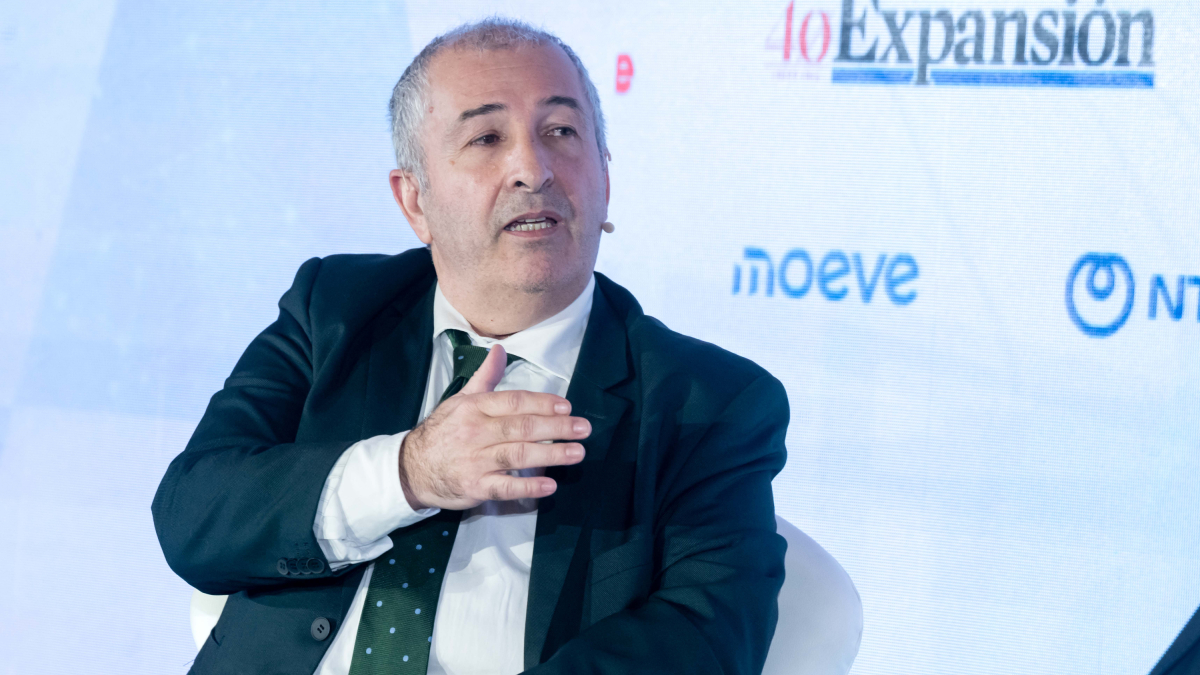
Enrique Ávila, director of the Artificial Intelligence Reference Centre at Spain's Defence Joint Chiefs of Staff, warned that protecting Spanish citizens and national sovereignty in cyberspace requires private industry and the public sector to unite under a shared patriotic and strategic purpose. Speaking at the fourth edition of the Expansión Artificial Intelligence and New Technologies conference, he said the country itself was at stake.
Ávila, who heads the centre within the Joint Cyberspace Command, used a stark image to describe humanity's current position in the face of the technological revolution: he said people today are like a monkey handling a gun, a weapon loaded with live ammunition whose destructive potential is obvious, but whose limits those holding it, much like the monkey, barely understand.
He said that in a military setting, this problem takes on the character of a national emergency. Making a mistake with that weapon, or allowing it to fall into an adversary's hands, is not a simple technical failure but a direct threat to the survival of the state, he said.
No Room for Failure
Ávila said the absolute priority for his command was unambiguous: protecting Spaniards and preserving the integrity of the state, a mission with no second chances. He said they had to be especially rigorous, since their business is the theatre of operations and their mission is safeguarding the sovereignty of the state and the protection of its territory and citizens. He said failure cannot be accepted in their line of work, and that if they fail, the country has a problem.
Ávila said security is no longer only a matter of borders but of protecting the foundation society rests on. He noted that the planet could naturally sustain only around 2.8 billion people, yet today it supports 8 billion thanks to technology. He described technology as the underlying structure on which the whole social, economic and political order has been built, saying it helps society grow and manage complex processes. Shielding the country's critical and intangible infrastructure, he said, is ultimately about shielding its people, because that technology is what allows citizens to live the comfortable life on which the entire social model has been built.
A Shared Mission, Not Just a Contract
Pedro Biurrun, deputy director of Expansión, noted during the session that European defence budgets are rising alongside insatiable demand for disruptive technology, leaving Spain's business ecosystem at a crossroads. Entry barriers into the defence sector are enormous, and for Spanish small and medium-sized companies, covering development costs without the backing of a large consortium is nearly impossible.
For the Joint Chiefs of Staff, Ávila said, the real challenge lies not in budget lines or profit margins but in strategic awareness. He called for breaking away from a purely commercial relationship between the administration and companies, saying public-private collaboration is good but that the military also has a mission, and that mission must be shared between the public and private sectors given what is at stake.
Winning at Any Cost
While markets reward financial return and operational efficiency, Ávila said the armed forces work under a non-negotiable principle: absolute effectiveness. He said he would use a term not usually heard in business circles, that the military also has to be effective, meaning winning at any cost. Defeat on the battlefield, he said, does not show up as losses on a balance sheet but as a breakdown in the security of millions of citizens.
In this field, Ávila said, the most profitable investment in military artificial intelligence is the kind that never has to be fired in open combat: deterrence. He said deterrence means never having to prove that what you did, you did well, and that if at some point you do have to prove it, it means a conflict has already begun. He said artificial intelligence must provide immediate response capability and such overwhelming superiority in gathering data that it neutralises any adversary's hostile intent in advance.
Building Fully Sovereign Systems
To fight this battle without compromising state secrets, Ávila said Spain has had to take on an enormous challenge: giving up standard commercial technology solutions when it comes to classified military information and developing fully sovereign capabilities instead. He described deploying the country's own artificial intelligence infrastructure as a true ordeal.
He said the process demands deep knowledge of the systems, the regulations and how they are deployed, calling it an extreme undertaking requiring impenetrable physical and logical security protocols. Asked whether Spain had managed to achieve this, he said yes.
Ávila said learning to control that metaphorical weapon without shooting oneself in the foot requires technology, but above all sovereignty, talent and operational independence. When defending the homeland and safeguarding its citizens is the primary mission, he said, technology stops being a business and becomes a national duty. Asked in turn whether Spain has the capabilities, the talent and the will needed, he answered yes, yes, and that he hoped so.
Test yourself
What role does Enrique Ávila hold?
What metaphor did Ávila use to describe humanity's current position with AI?
What population figures did Ávila cite regarding technology's role in sustaining society?