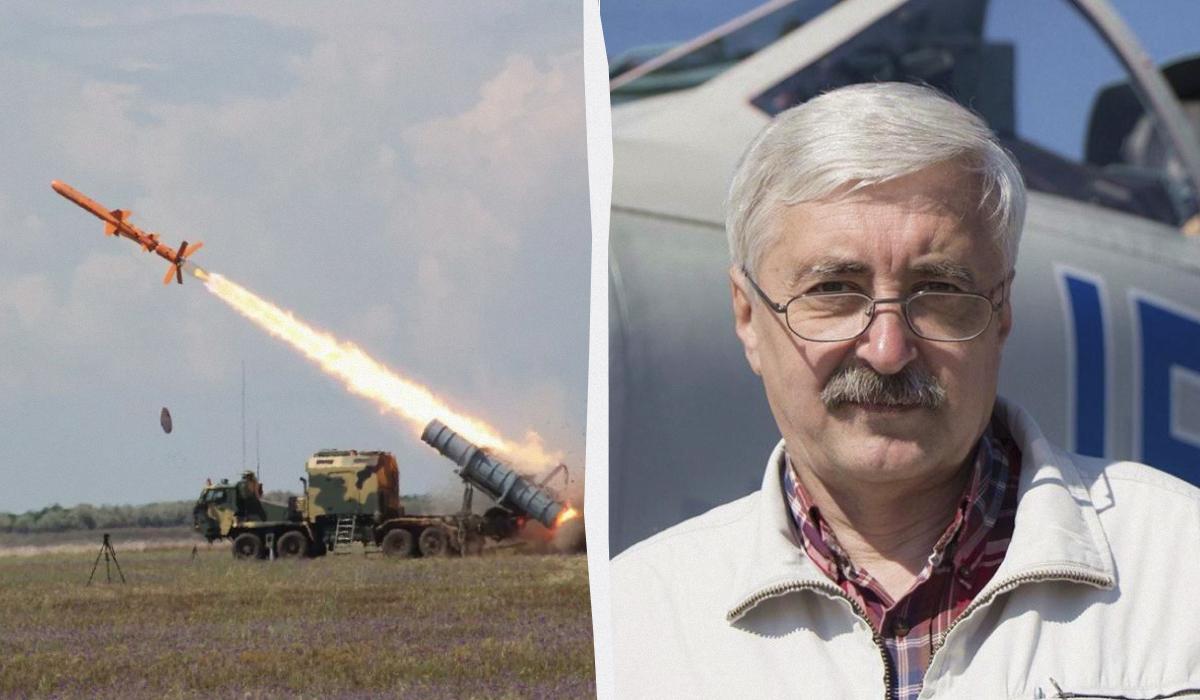
Ukraine's Neptune cruise missile, though not one of the country's newest designs, has become one of its most effective weapons against Russian military targets, according to Valeriy Romanenko, an aviation expert and leading researcher at the State Aviation Museum in Kyiv.
Romanenko told the UNIAN news agency that when compared with newer Ukrainian missiles such as the Flamingo, the Neptune still delivers solid results. He said a strike on the Crimean Bridge using the missile produced no particular result, but that strikes on Russian airfields and enterprises in nearby regions had been effective.
Romanenko said that in October 2026, Neptune missiles destroyed six carriers of KAB guided bombs at Russian airfields. He said Ukraine's coastal missile complex struck the Borisoglebsk military airfield in Russia's Voronezh region, destroying four aircraft and damaging two others. He added that the long-range variant known as the Dovhyi Neptun, or Long Neptune, also struck the Marinivka airfield in Russia's Volgograd region, destroying two Su-34 fighter-bombers.
He also recalled that an anti-ship version of the Neptune was used in April 2022 against the flagship of Russia's Black Sea Fleet, the cruiser Moskva. Romanenko said the same anti-ship variant was used again in a November strike on the Crimean Bridge, because the bridge's metal structure suits the missile's homing head.
Origins of the Neptune design
Romanenko said the Neptune is a genuine missile built by designers with deep experience, pointing to the Luch Design Bureau, which previously developed the R-27 and R-73 missiles that served as the Soviet Union's main air-to-air weapons during the Cold War. He said Luch now produces upgraded versions of those missiles for Ukraine's Su-27 and MiG-29 fighter jets.
By contrast, he said, the Ukrainian company Fire Point, which makes the Flamingo missile, had to start from nothing, bringing in some specialists but lacking that institutional background. He said Fire Point ran into numerous setbacks and early problems, effectively having to build its missile from whatever was available, including standard aviation engines taken from training aircraft. The Neptune, he said, uses solid-fuel engines and has proven to be a success.
A hard target for Russian air defences
Romanenko said the Neptune has a small radar cross-section. He said it does not follow the trapezoidal shape used in newer missile designs to reduce radar visibility, but its cross-shaped tail fins for maneuvering and relatively compact size still make it harder for enemy air defense systems to detect. He said the land-based Tovstyi Neptun and Dovhyi Neptun variants are similarly compact, which also makes them difficult for Russian radar to pick up.
From coastal weapon to long-range missile
Romanenko said the Neptune was originally built as a coastal defense missile before land-based versions were developed: the Tovstyi Neptun, also called the Puzatyi or Potbellied Neptune, and the Dovhyi Neptun, or Long Neptune.
He said the Tovstyi Neptun has a range of around 500 kilometers and carries a 150-kilogram warhead. The Dovhyi Neptun, he said, carries a warhead of 260 to 350 kilograms and has a range of about 1,000 kilometers, with its body diameter increased to 50 centimeters.
Romanenko said the changes were made to the missile's central section, with larger wings and a wider diameter allowing room for more fuel, more electronic equipment and a bigger warhead.
Ramping up Neptune production
Romanenko said Oleg Korostelov, general director of the Luch Design Bureau and one of the Neptune's developers, has said Ukraine is now producing the missiles in the hundreds. Romanenko estimated the true figure at roughly 800 missiles a year, short of a thousand.
He said a higher output would strengthen Ukraine's long-range strike capability. According to Romanenko, Ukraine can now hit any target within about 800 kilometers of its borders or the front line, which covers most Russian enterprises, including those in Krasnodar region. He said the Tovstyi Neptun can reach targets in Russian regions bordering Ukraine, while the Dovhyi Neptun can reach the Volgograd region, the Moscow region, the city of Moscow itself, and the Tula region, which he described as a hub of Russian weapons manufacturing.
Romanenko said targets further inside Russia could be struck with Flamingo missiles, while Russian oil refineries on the Sea of Azov coast could be hit even with the standard anti-ship Neptune, which has a range of up to 300 kilometers and a 150-kilogram warhead. He said production is currently focused on the land-based Tovstyi and Dovhyi Neptun variants.
Wider weapons production plans
UNIAN previously reported that Korostelov told The Wall Street Journal that Ukraine plans to produce hundreds of Neptune cruise missiles in 2026, along with more than a thousand small UAV-290 Palianytsia cruise missiles. He said Palianytsia production has already topped a thousand units a year, and that the plant could increase missile output further if given additional funding.
What happens next
Ukraine is prioritizing production of the land-based Tovstyi and Dovhyi Neptun variants, and plans to build hundreds of Neptune missiles plus more than a thousand UAV-290 Palianytsia missiles in 2026, according to Luch Design Bureau's Oleg Korostelov.
Test yourself
Who is the aviation expert quoted on the Neptune missile?
What is the approximate range of the Dovhyi Neptun (Long Neptune)?
What happened to the Russian cruiser Moskva in April 2022, according to the article?