Asteroid 99942 Apophis will pass close to Earth in April 2029, but researchers warn space debris could collide with the cosmic rock. The asteroid, a cosmic fragment about 370 meters long, will fly within 32,000 kilometers of Earth. That distance is close to the orbit where many telecommunications satellites operate.
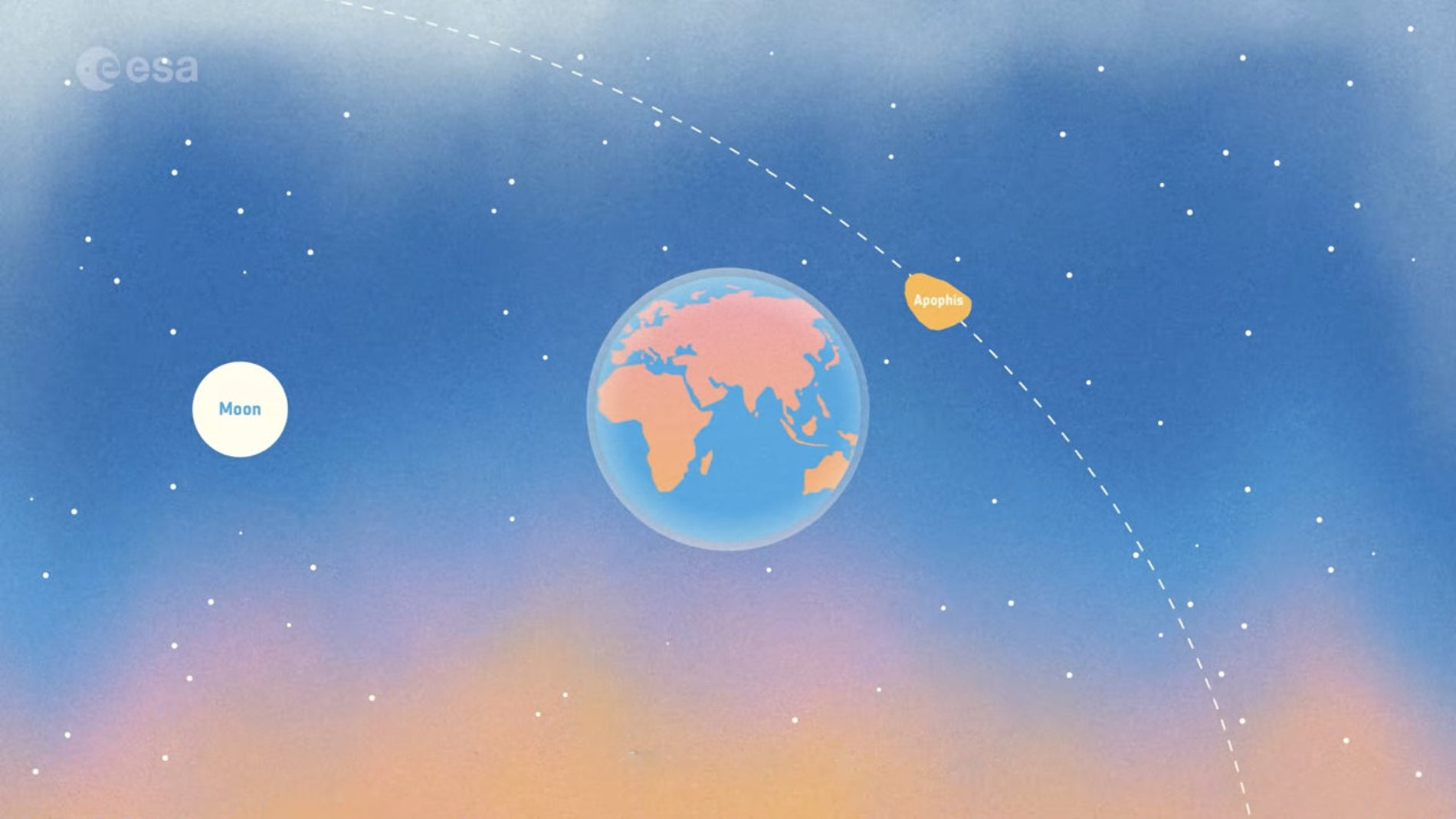
Scientific calculations repeatedly confirm that Apophis poses no threat of impacting Earth during the flyby. However, as the asteroid approaches, Earth's strong gravitational pull will alter its rotation, trigger potential landslides, and cause earthquakes on the rock itself. These physical disruptions will reveal secrets hidden beneath the asteroid's surface. Two space missions, the European Space Agency's RAMSES and NASA's OSIRIS-APEX, are scheduled to observe the event in detail.
Space Debris Collision Risks
Physicist Giulia Schettino and astrodynamicist Alessandro Rossi, from the Nello Carrara Institute of Applied Physics of the National Research Council of Italy, warned that human space junk could interfere with these observations. Rossi, an expert in space debris and asteroid dynamics, analyzed whether Apophis could strike human-made debris at its closest point.
The researchers simulated the trajectory of Apophis through the geostationary orbit region at an altitude of about 36,000 kilometers. They included both known orbital objects and an estimated number of fragments that current radar systems cannot detect. Although the team initially expected no interactions, the simulation revealed a small but real probability of a collision between space debris and the asteroid.
Impact Consequences and Detection
Scientists clarified that a potential collision would not knock Apophis onto a dangerous path toward Earth. The impact would also not cause a chain reaction of collisions known as Kessler syndrome, because space junk in high orbit is widely scattered. A collision would likely only form a small crater on Apophis, which could be detected by seismometers and gravimeters that the RAMSES mission plans to deploy on the asteroid's surface.
The primary issue for researchers is that an impact would complicate scientific interpretation of the flyby. Astronomers aim to study how Earth's gravitational force naturally deforms and alters the asteroid. If space debris strikes Apophis shortly before or during their observations, scientists will struggle to separate changes caused by Earth's gravity from those caused by the collision.
High Orbit Space Junk Tracking
The study highlights how little is known about tiny space debris in high Earth orbit. While larger objects are tracked regularly, thousands of smaller fragments remain invisible. Experts hope the passage of Apophis will encourage improved space surveillance through new telescopes that the European Union plans to launch in coming years, allowing precise mapping of high-altitude space junk before the flyby occurs.